Saudi Arabia · Riyadh · Jeddah · Eastern Province · NEOMProject enquiries · Secure request form
Case study · Qiddiya City, Riyadh

Qiddiya Guardrail Post Integrity Testing

Dynamic integrity testing of 550 guardrail posts in Qiddiya City, Riyadh, using repeatable field measurements to assess post response and support embedment / installation verification.

LocationQiddiya City, Riyadh
ServiceDynamic Integrity Testing
Scope550 guardrail posts
Depth / targetEmbedment verification
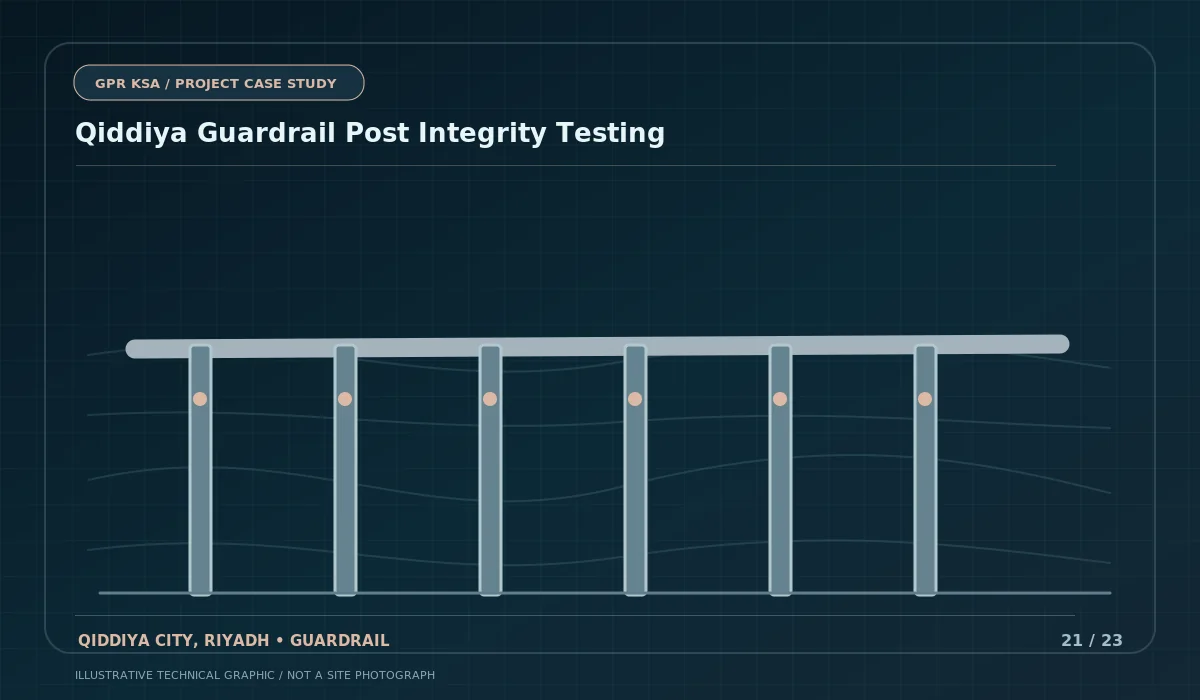
Project-specific illustrative technical schematic, not a site photograph or as-built drawing
Technical illustration
Project context

Why this investigation mattered

The assignment was different from a typical underground utility survey: the target was a large population of installed guardrail posts requiring consistent integrity assessment. With 550 posts, repeatability and traceable field records were more important than one-off measurements.

The project needed a workflow that could capture comparable data efficiently while still identifying posts whose response differed from the expected pattern and therefore warranted review.

Investigation strategy

Testing was organized as a repeatable production workflow. Each post was assessed using the specified dynamic measurement approach, with three channels recorded per test point to provide a consistent basis for comparison.

Results were reviewed for response quality and anomalies that could indicate differences in embedment or installation condition. The focus was on asset-level verification rather than subsurface utility mapping.
Field-to-report workflow

How the project information was developed

The workflow is documented so the case study provides engineering context—not just a marketing summary.

  1. 01
    Establish the testing sequence and identification system for 550 posts.
  2. 02
    Capture three-channel dynamic data at each specified test point.
  3. 03
    Check data quality in the field to avoid incomplete records.
  4. 04
    Review response consistency and flag anomalous posts for engineering attention.
  5. 05
    Compile the asset-level results for project verification.

Interpretation and engineering use

A repeatable asset-testing workflow gave the project team a consistent evidence base across hundreds of installed posts, making it easier to identify exceptions that required further attention before operation.

Quality control

  • Consistent test procedure applied across the asset population.
  • Post identification maintained through field capture and reporting.
  • Data-quality checks performed before leaving each work area.
  • Anomalous responses separated for review rather than averaged into the overall set.

Project deliverables

  • Guardrail post test register.
  • Dynamic response records.
  • Identification of anomalous / review-required posts.
  • Project reporting for integrity / embedment verification.

Technical limitations

Dynamic integrity testing should be interpreted within the specified test method and engineering acceptance criteria. It is not the same as GPR utility detection, and conclusions should remain tied to the measured structural response.

Project FAQ

Questions this case study answers

How many guardrail posts were tested?

The project scope recorded 550 posts.

How many data channels were collected?

Three channels per test point.

Was this a GPR utility survey?

No. This case study concerns dynamic integrity testing of installed guardrail posts.

Plan before you excavate

Need subsurface information for a project?

Send the site location, survey area or route length, target depth and available drawings through the project request form.